
+44 (0)1440 564988
Consultation on the storage and retention of original will documents
You may have read in the recent press, and on social media, of the Ministry of Justice (MoJ)’s open consultation on ‘the Storage and retention of original will documents’. The title is misleading. If you read the text of the proposal, it soon becomes clear that it is a consultation on the digitisation and subsequent destruction of original will documents.
You can read the details of the consultation here: Storage and retention of original will documents
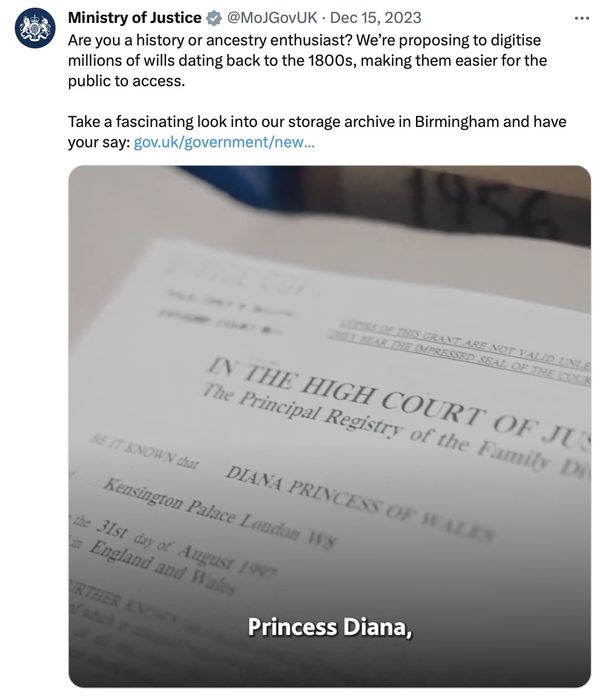 What is also interesting is that the MoJ’s post on this on social media (left) highlights only the positive elements of the proposed changes, whereby millions of wills will be digitised, linking to this press release. The press release does mention and link to the consultation but, again, focuses on the positives of the digitisation for ‘genealogists, historians and amateur family archivists’.
I think we can all agree that, for anyone undertaking historical research of any kind, digitisation has significant positives, both from an access perspective and from a conservation point of view. After all, less requirement for access to originals equals less wear and tear, right (caveat: assuming appropriate storage of the originals)?
However, the question here is does digitisation of an original record result in the digitised copy being a suitable replacement for the original?
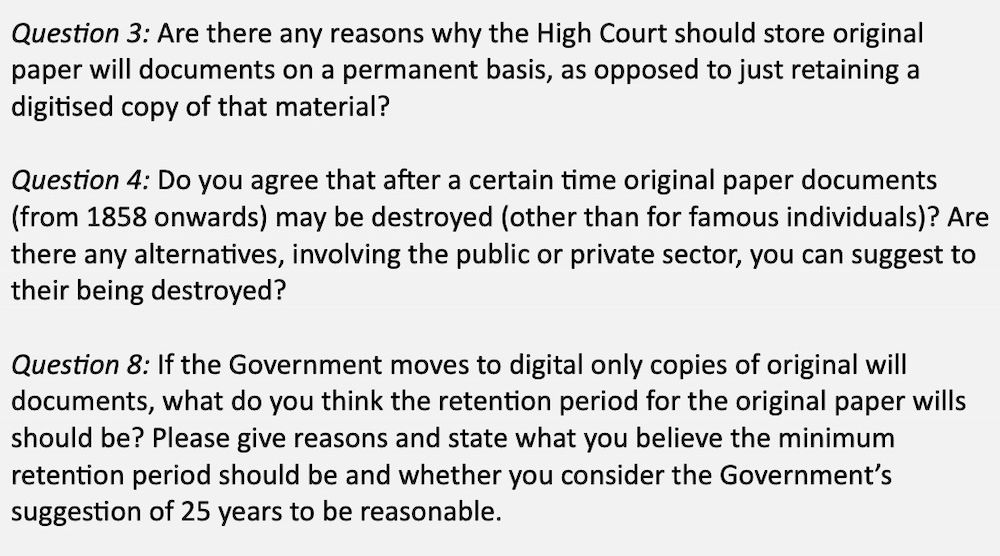
From the consultation:
Let’s start by thinking about the limitations of digitisation processes. The aim of digitisation is to provide an exact reproduction of an original document. However, from experience of working with digitised copies of documents for many years we know that there are often issues with the process itself. Sometimes sections of a page are missing, perhaps omitting important information or margin notes, often a decision is made not to copy the reverse side of documents, and these too can include added notes which are of significance to the researcher. It could be argued that these omissions could be avoided with a policy from the outset to include full copies of all pages, front and back, of all documents. Is that the plan for wills? That is not clear from the information provided in the consultation and would undoubtedly be a far more expensive option. However, even if the plan is to copy all pages, errors still occur. One only has to look at examples of digitised parish register collections available online to find examples of poor quality copies, missed pages from registers, and pages catalogued under the wrong part of a collection, making them almost impossible to find. These are not examples from digitisation projects produced by small groups of volunteers either, they are found at the ‘big’ family history websites, where you would expect there to be an experienced team of appropriately trained people carrying out the digitisation process. The process is just not infallible. It cannot be guaranteed that every part of every document has been digitised as a good quality copy without a 100% quality inspection, which would be extremely cost prohibitive.
Moving onto the need for access to the original documents themselves. For many family and local history researchers and historians it is access to the information contained within the documents that is important. If we could guarantee 100% replication of the original documents as digital copies that would satisfy the needs of many of us. But there are exceptions. Archivist Sally says on X ‘We have had people visit us just to measure wills and examine the ink and paper used! The physicality of an archival record matters!’ There are many reasons for historical research and the ability to access original records remains important even if digitised copies are available.
How about the longevity of use of the digital format chosen? This piece in the Guardian summaries this well ‘The Guardian view on digital-only archives: material items still matter to historians’. If a digital format is to replace a paper copy then it must stand up to the test of time. That means constantly reviewing and updating technology and converting one format to a newer one as old technology becomes obsolete or starts to degrade. Any copying process introduces the possibility for errors, corruption of files and / or the loss of data. The costs for this must also be factored into the planning process. A suitable comparison is the digitisation of all records held on microfilm by Family Search. However, the risk of data loss resulting from a reliance on digital copies of records only is just too high.
A further aspect to the consultation is the proposal to preserve the original wills for ‘famous people’:

There are two points here that concern me. Firstly, how do we decide who is important enough to come under the category of ‘famous’? It can only be a subjective assessment and there are some people for whom their 'significance' may only become apparent after their original wills have been destroyed.
Secondly, quoted as evidence here is the fact The National Archives preserves the wills of the famous before 1858. Well, yes it does, in class PROB 1, but original wills are also preserved for ‘regular’ people in class PROB 10. You can read more about this in Dave Annal's excellent thread on X.
The MoJ consultation is motivated by ‘the very high cost of preserving the store of original paper wills and the supporting documents supplied in probate applications’ which it estimates at £4.5 million per annum. What is not clear is whether that is the current annual cost, which presumably includes the provision of staff and resources to provide copies to the public on request, or whether that annual cost will significantly reduce once the digitisation process is complete and the need for access to original documents is minimised. Not declared is the cost of the need to constantly review and update technology as discussed above.
The attached video in the MoJ social media post highlighted above states that the digitisation process will take 15 to 20 years to complete. However, it is not clear whether the proposed destruction of original documents would begin once the digitisation project is complete or whether this is planned to be carried out on a batch by batch basis.
It is therefore important to have your say now! I will be summarising the points above in my formal response to the consultation.
How can you make a difference?
In order to make a difference I urge you to do two things:
(1) Respond to the consultation yourself:
Storage and retention of original will documents
Will Storage consultation
Ministry of Justice
Civil Justice and Law Division,
Postpoint 5.25
102 Petty France
London
SW1H 9AJ
Email: civil_justice_poli@justice.gov.uk
The consultation closes on 23rd February, 2024.
(2) Sign the petition started by our tutor, Richard Holt:
Petition: do not allow original wills to be destroyed after 25 years
You can read more from Richard on this here: Justice for Wills and Probate Documents.
Karen Cummings
Managing Director, Pharos Tutors®